1) Do you have any writing routines?
I start writing as close to waking up as possible, while my brain is still fresh. I often go to a café and work there with a coffee and headphones. I find it helps to get out of the house – something that I only fully appreciated after several lockdowns!
In the afternoon, I try to go for a walk and mull over what I’m working on. Then I tend to edit whatever I wrote in the morning.
None of this is set in stone, but that is the rough shape of my ‘writing day’.
2) How do you construct your story arc – do you plan or just see what happens?
I’m definitely more of a ‘pantser’ than a planner (someone who writes by the seat of their pants). I think part of the joy (and horror) is making up the story as you go along. Then I go back and edit. I spend a lot of time editing.
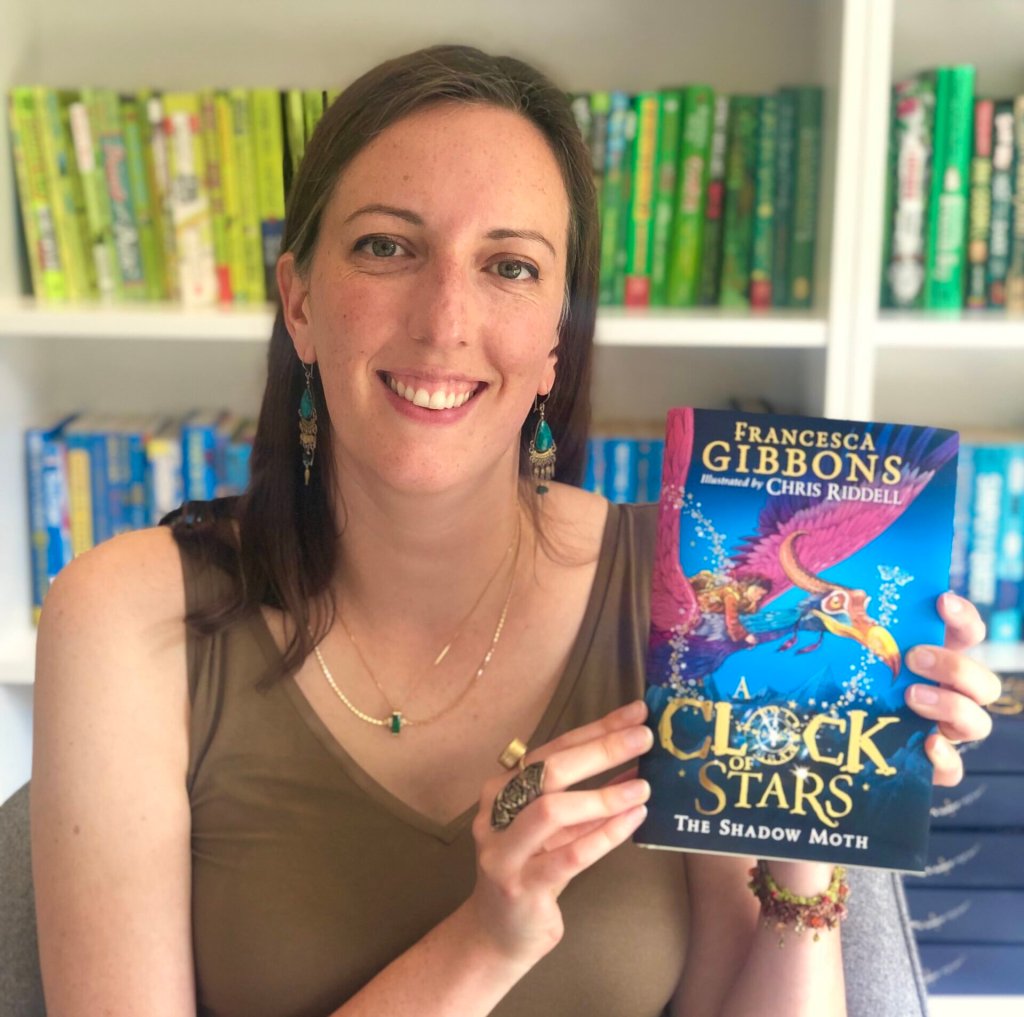
That said, I often have a few key moments in mind, that I know I want to weave into the story. For example, I might know that I want a flying scene where the children escape on giant birds (this happens in my first book, The Shadow Moth).
I do like to know what’s happening in a chapter before I try to write it and, if I don’t know, I find that walking is a good way to find out. Ideas often come to me on walks – or shortly after them, when I’ve allowed my mind to wander.
I also write a lot of things that get thrown out. I will often write one chapter multiple ways before I can tell which plot option works best.
3) What do you hope for in your future as an author?
I hope to be able to continue writing children’s books for my living. Ever since I was able to hold a pen, this has been my dream.
4) Are there any books already published that you wish you had written?
There are many books that I love, but I don’t tend to think in those terms. I suppose a lot of my favourite books surprise me – and that’s partially why I love them. There is no way I could ever have written them.
Here are some children’s books I’ve enjoyed recently: The Strangeworlds Travel Agency series (L.D. Lapinski), Run, Rebel (Manjeet Mann), Starboard (Nicola Skinner).
5) If you weren’t a writer what job would you have?
I would be a copywriter. That is what I did before I got my book deal and that is what I still do, between book deadlines, on a freelance basis. Most of the work I do is for charities and conservation organisations.
It’s still writing and it’s still creative, but there’s a lot about it that’s different to writing novels for children. I find the contrast refreshing.
I also find that copywriting inspires me and takes me outside of my comfort zone, giving me opportunities to learn about things that I wouldn’t normally come across.
For example, I did some work last year for the RSPB, who own many wetland reserves. It’s no coincidence that a marsh has become a huge feature of my third book.
6) Which character in A Clock of Stars do you most identify with personally?
I am going to have to say Imogen, my main character. I identify with all of the characters to some extent, but she is the most similar to my childhood self.
She’s very much an eldest child, who can be a bit mean to her sister, but who is looking for adventure and trying to take control of situations as they arise.
7) What can we look forward to from you in the future? Thank you!
The only thing I know for sure is that I intend to keep writing!
I’m editing the third Clock of Stars book at the moment, and I’ve been working on this trilogy for about ten years. I haven’t really had the head-space to think about what might come afterwards. I’ll definitely post on Twitter when I know the plan!
 Kinkajousreadtoo
Leave a comment