
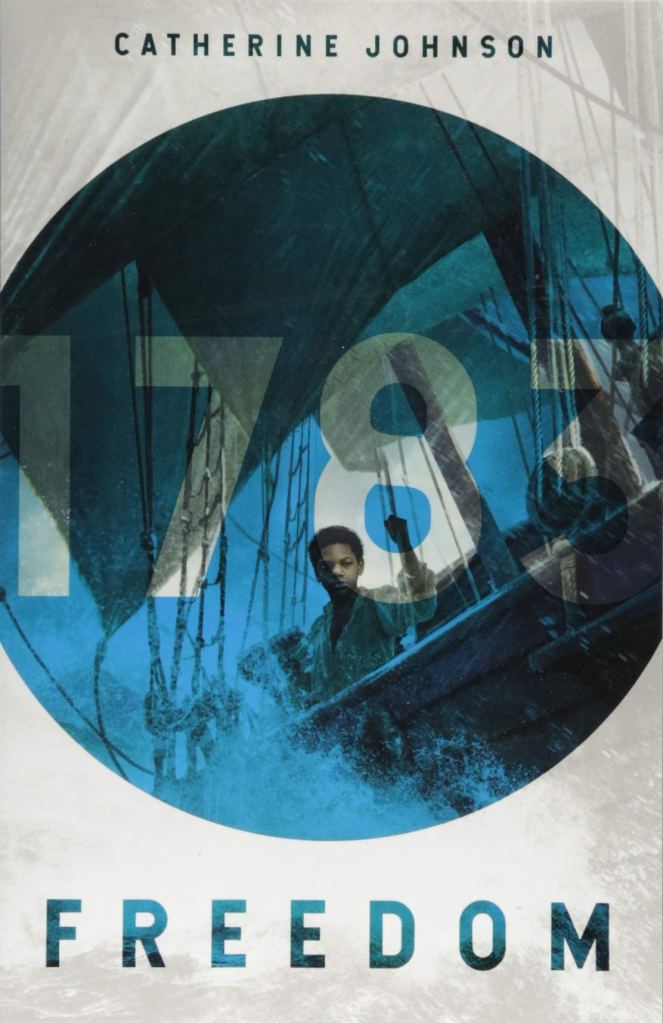
Freedom by Catherine Johnson
Cover artwork by Two Dots
Published by Scholastic £4.99
ISBN: 9781 4071 85484
Published: 2nd August 2018
138 pages
Author’s contact details:
http://www.catherinejohnson.co.uk
@catwrote
Illustrator’s contact details:
Publisher’s website:
@scholasticuk
Under 100 characters book review:
Beautifully written story about a slave boy in Jamaica and the continuing battles he goes through to become free.
The first line:
I swept the paths in the flower garden as if I was the devil cutting down every sinner in hell.
The key characters:
- Nathaniel Barratt (a slave)
- Old Thomas (a slave who works in the garden)
- Master Barratt (the plantation owner)
- Mistress Barratt (the plantation owner’s mother)
- Mr Bird (the mistress’ parrot)
- Missis Palmer (the house keeper)
- Mary Lee (servant in London)
- Henry Hughes (ship’s boy)
- Mr Shadrack Furman (free man in London)
- Mr Kelshall (the ship’s mate)
What do you need to know?
The story centres around, Nat, a slave boy on a plantation in Jamaica, in 1783, at the height of the slave trade. He is desperate to be freed, so that he can find and rescue his mother and sister, who have been taken to another part of the island. This dream becomes more and more distant and harder to hold onto, as his owners take him to England to look after some pineapples. Once there, they plan to sell him to rich noble.
My review:
I loved reading this story! Even thought the subject matter is complex, dark and morose, the story is told with great warmth. The language and the actions of each character fits perfectly with their role within the story, and the plot is kept simple in order to enable the characters to develop and interact with each other. As you make your way through the story, you feel the frustration and bottled up anger that the main character goes through in each scenario, and you will him to be brave and take the plunge into the unknown, by escaping his owners. Though certain brutal moments make you furious, you can understand that at the age he lived in and his terribly young personal age, how difficult it must have been to see anything other than the life he lived. His luck in meeting Mr Shadrack Furman was a little hard to believe and felt a little contrived; however, this enabled the story to go into the actual historical account of the slave ship, the Zong, and the beginning of the end for the slave trade. Included at the end of the story are some fascinating historical facts about some of the characters in the story.
How could it be used in school?
(SPOILER ALERT!)
All ideas are linked to the National Curriculum
CORE SUBJECTS
ENGLISH:
Nathaniel’s feelings are really well described in the story – his frustrations and his difficulties in understanding the life he is forced to live. This could be looked at closely and then used to write a diary entry for different parts of the story.
Throughout the story, Nat is focused on trying to find his freedom and some money in order to go and rescue his mother and sister. With no way to contact them, he cannot tell them what is happening to him. But, what if he could write them a letter (he hasn’t been taught to read and write), what would he say?
What has happened to his mother and sister? It would be interesting to see what their story is. Children could use the same style of writing as Catherine Johnson and include historical facts into their writing – Jamaican phrases, flora and fauna, food and slave activities.
I would also like to put the story of the Zong slave ship on trial. You could take the idea to court, re-enact all the different things that people might say, and then write passion persuasive piece for either side to be presented in the courtroom!
SCIENCE:
Parrots or a particular parrot is a key bad character in the story! KS2 children need to learn about life cycles, and you could focus, not just on the human life cycle, but also compare this to a parrot’s life cycle.
The pineapples have to make a 3 month voyage at sea. Children could be set a task to design the best container to keep them in. Children in Year 5 need to learn about the different properties of materials, and could use this knowledge to solve the problem. They could then compare their own ideas with those of Nat and Old Thomas’ idea.
Children in Year 5 need to learn about space and the constellations. The ship’s sailors on the boat from Jamaica to England would have used this knowledge in order to make the route and children could learn how this was done.
Nat needs to escape from the Barratts’ house when they are in England; however, he is locked up at the top of the house. How could he escape with the resources he has at his disposal and the children’s knowledge of forces – gravity, air resistance and friction?!
Living Things and their habitats is a topic taught in Year 6 – the children could learn about the classification of fruits and the pineapple in particular.
FOUNDATION SUBJECTS
ART AND DESIGN:
This is a highly emotional period of history and it would be interesting for the children to try and express the feelings of some of the characters in an abstract form, looking at how colour can represent emotions and how different mediums – clay, paint, charcoal, pencil – can put forward a point of view.
GEOGRAPHY:
It would be fascinating to look closely at the Caribbean and all its different and very varied islands and then perhaps focusing on the island of Jamaica as a topic. Children could make fact files about the island and look into its varied history from the 18th century to the present day.
MUSIC:
The Caribbean has a wonderful history of music from slave songs to reggae and the children could look into all these different aspects and learn about particular musicians. It would be great for children to then create their own music inspired by this research and learning. This could also link into writing poetry – there are great many wonderful Caribbean poets to study: such as Valerie Bloom.
HISTORY:
The story is set during the 18th century slave trade and I think a lot of work would need to be done in order to enable children to understand this period of history. This would also enable them to write as if their characters were around at this time. Children would need to know about daily life in the 18th century in the Caribbean, as well as how the slave trade starter, what is was for and how it continued for so long.
If you liked this, you might like to try reading:
- Onjali Rauf
- Patrice Lawrence
- Nadine Wild-Palmer
Where I received the book:
Cheltenham Festival’s Reading Teachers = Reading Pupils (2020-2021) project
 Kinkajousreadtoo
Leave a comment