Published by Orion
£6.99
ISBN: 9781510105485
Pages: 229
Author contact details:
www.jessbutterworth.com
@J_T_Butterworth
@sallyanne_s
#swimmingagainstthestorm
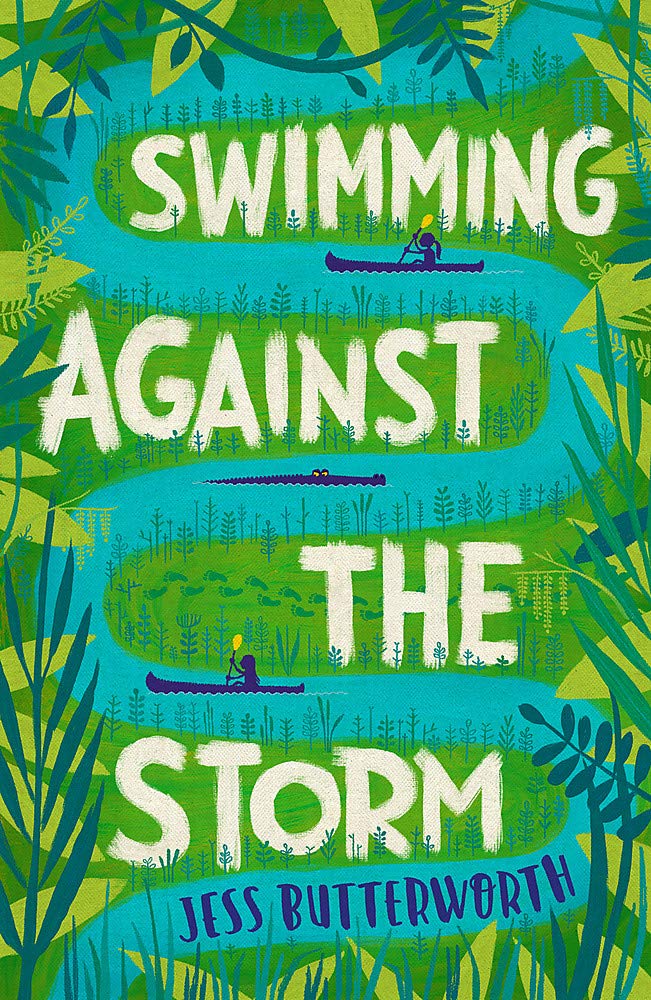
Cover illustrated by:
Rob Biddulph
@RobBiddulph
Inside map drawn by:
John Oliver
Publisher website:
www.hachettechildrens.co.uk
@HachetteKids
Under 100
characters summary:
Eliza & The Canailles race through a hurricane to search for the loup-garou, which they think will save their home.
The first line:
Our land is sinking.
My review:
Wherever you go in the world there are always mysterious creatures that are made up from half stories, past-on ramblings, and far fetched sightings and perhaps just an inkling of truth. The same can be said of the creature hiding in the huge, wide marshes of Louisiana: the loup-garou. As famous and uncatchable as the yeti or Bigfoot or the Loch Ness Monster – he’s still out there, somewhere. And, what do you do if the land you live on and call home is sinking? You go and find him, don’t you, so that the land is protected by the government, who otherwise would have ignored you. That’s exactly what sisters Eliza and Avery decide to do, but as in all good adventure stories, that’s not exactly what happens – throw in a deadly hurricane, a lost child, alligators, a swamp hunt and a big, bad mining company and you have a drama which becomes very hard to leave. The pace is brilliantly posed and slowly builds to a crescendo, with you routing for the children. Written in a very American style (lots of explaining emotions and wrangling with those emotions) and in the first person, you quickly connect with the key characters. The two sisters are not just sisters, but best friends, and as they take you through the swamp land, you not only learn about their relationship, but also about their relationship with the land around them. Initially, I have to say I wasn’t drawn to the book from the front cover or the blurb, but I’m glad I waded through it, as you really are drawn into the beautiful world of the marshes and the people that live there, and I even get the colour of the front cover now: as Eliza says when she chooses the colour of her cast, “Green. The colour of the marshes.” Perfect for Upper Key Stage 2 children.
How could it be used in school?
With the wonderful description of the Louisiana swamp lands, this story could be used to compare life there with another place, such as where your school is situated.
The remarkably individual history of the area would be interesting to explore, along with the geography of the area, using John Oliver’s map in the front. Making their own version of the map, with your choice of material, could be interesting – I’d love to see it in mod-roc.
There are a huge variety of animals mentioned, which are likely to be unknown to your class, that could be explored and then turned into texts, such as a non-chronological report or a poster. This could also link to the science topic of food chains and food webs.
I would also like to explore boat making, as this is the main form of transport in the area – if you are lucky enough to have a pond in your school, there could be a great opportunity to have a go at boat building and scientifically testing them in a STEM style approach.
I would really want to know what the loup-garou looks like and this would lead to a nice visualising activity.
One of the key threats in the story is the hurricane and this would lead to the understanding of this and perhaps producing a weather report for the area. If you have the technology, this could be done with a green screen!
Lots of PSHE could be taken from the story as a whole, as there are strong themes of sibling rivalry and relationships, friendship (when to support them and when to not) and ultimately trust.
Clearly, the book’s main theme is one of protecting the environment, and this is a great, very current, topic for children to study. How could this area be protected, should it be? This would lead to a great courtroom scene I would think!
Some French is spoken in the book, as a common dialect in the area of Louisiana, so if your class is learning this language this is a nice link.
If you liked this, you might like to try reading:
- The International Yeti Collective by Paul Mason
- The Girl Who Speaks Bear By Sophie Anderson
- Where The World Turns Wild by Nicola Penfold
Where I received the book:
UKLA 3-11 magazine
A full review is available in the UKLA’s 4-11 magazine, along with many other reviews of books for children, along with many interesting and thought-provoking articles – https://ukla.org
 Kinkajousreadtoo
Leave a comment